Lights
One of the most common reasons — and the easiest to fix. Blown bulbs, an indicator that does not flash, brake lights that do not come on, but also badly aimed headlights that dazzle oncoming drivers. Cloudy or yellowed headlight lenses also reduce light output.
Before you come, check all your lights with a second person — see our guide How to prepare your car for the KTEO test.
Brakes
On the brake tester we measure braking force at each wheel separately. Besides worn pads and discs, a common problem is imbalance: when one wheel brakes noticeably less than the other on the same axle, the car pulls to one side. A weak handbrake is also common.
Tyres
- Tread below the legal limit (1.6 mm for cars)
- Cracks, bulges or cuts
- Different tyres on the same axle
- Sizes that do not match those permitted for the vehicle
Suspension and steering
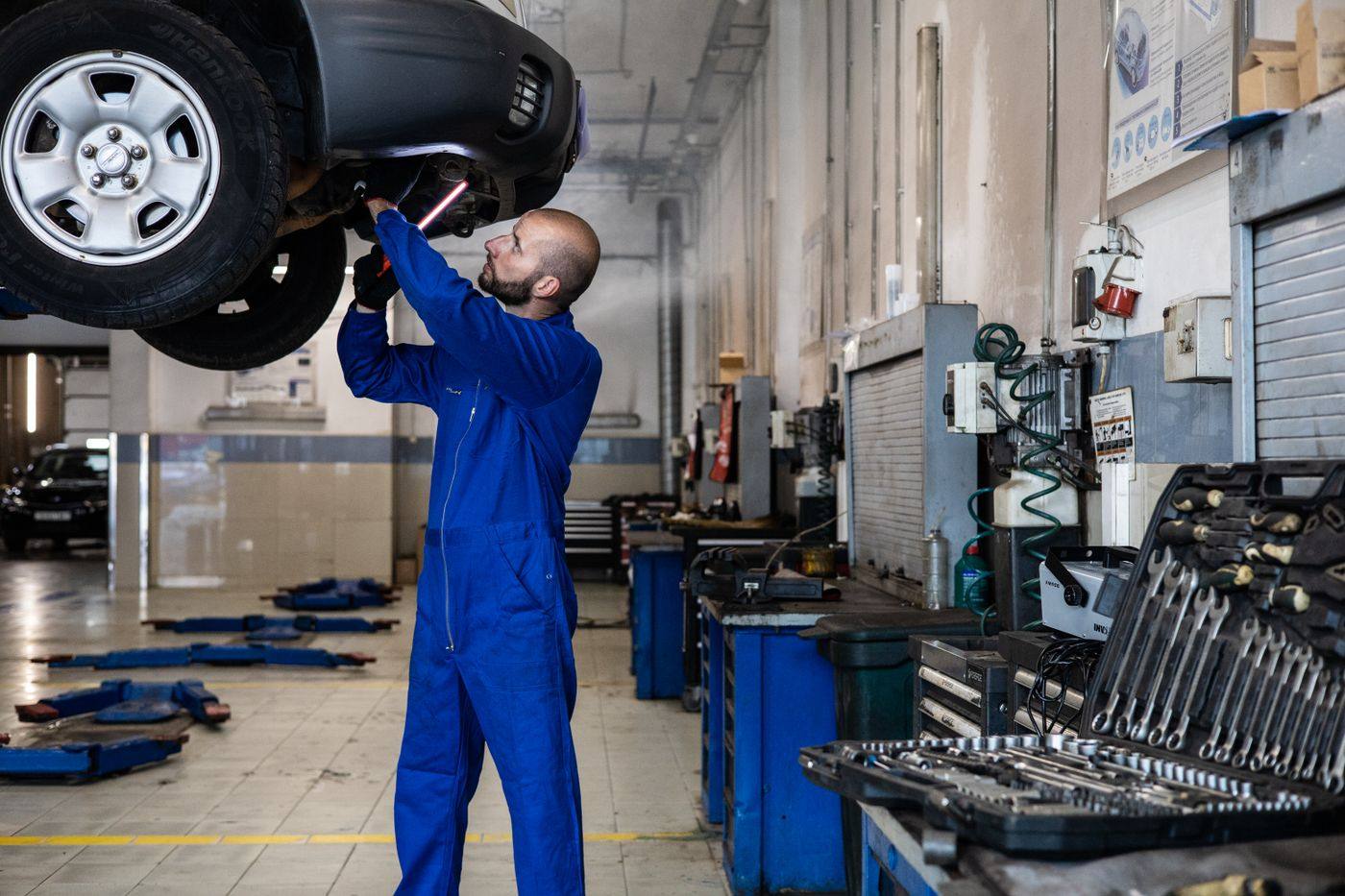
On the lift we check for play — looseness in track rod ends, ball joints and mounting points — as well as worn shock absorbers. Drivers often do not notice, because it develops gradually. Signs: knocking noises over bumps, a steering wheel that does not sit straight, uneven tyre wear.
Emissions
High emissions on petrol cars usually point to a combustion or catalytic converter problem. On diesels we measure smoke opacity (black smoke). An engine warning light on the dashboard is often an early sign.
Arrive with a warm engine — after 15–20 minutes of driving. A cold catalytic converter does not work properly and the measurement does the car no favours.
Rust
Rust on load-bearing parts — chassis, suspension mounts, sills — is a safety issue, because that is where the car’s strength in a crash comes from. In coastal areas like ours, salty sea air speeds up corrosion — especially on cars that sit unused near the sea for long periods.
Leaks and exhaust
Oil, brake fluid or fuel leaks are spotted on the lift. A holed or badly mounted exhaust is also recorded as a defect — and you can usually hear it coming.
Seat belts, horn, wipers
Small things that get forgotten: a rear seat belt that will not retract, a horn that does not work, wiper blades that have hardened in the sun.
Unapproved modifications
Changes that are not approved or not recorded on the registration certificate can lead to a fail — for example bulbs not designed for that headlight unit, or tyres outside the permitted sizes. If you are thinking about a modification, ask us before you make it — we will tell you whether it is allowed.
What if my vehicle fails?
It is not a disaster. We explain in detail what we found and give you the certificate listing the defects. Once they are fixed, you come back for a re-inspection, where we only check what is needed. It costs €5 — you do not pay for the full test again.
Do not leave the re-inspection too long: if it is late, a small surcharge is added. Ask us about the deadline for your case on +30 28410 21111 — we speak English.
Frequently asked questions
Will you explain what you found?
Always. All three of our inspectors are mechanical engineers and they explain in plain words what they saw and what needs doing.
How much is a re-inspection?
€5. We only check the points that were recorded as defects.